

Call for Applications:
A call for applications has been announced for Erasmus+ Staff Mobility for the period from January 1st, 2026 to July 31st, 2026.
Applications can be submitted from October 1st (6:00 AM) to October 31st (3:00 PM) via the IS Věda internal competitions application.
Detailed information can be found in the individual tabs below.
Employee mobility under the Erasmus+ programme can only be carried out if the outgoing participant is employed by the Faculty of Arts, Charles University under a valid employment contract, agreement to perform work (DPČ), or agreement to complete a job (DPP).
Duration of Stay
- Minimum duration of eligible activities is at least 2 consecutive days, excluding travel days (For the UK and Switzerland, the minimum duration is 5 days.)
- Maximum duration of eligible activities is 60 calendar days, excluding travel days.
Eligible Activities
- Teaching Assignment: continuous pedagogical activity, such as giving lectures, leading seminars, collaborating on joint/double degree programmes, consultations, etc.
- Staff Training: a wide range of activities including professional development, language and other educational courses, participation in staff weeks, job shadowing, etc.
- Combined Mobility: a stay that includes both teaching activities (as described above) and various forms of training (primarily job shadowing)
- BIP (Blended Intensive Programme): a collaboration of three or more universities, one of which organizes a workshop, summer school, or other intensive programme; the programme includes both a physical and a virtual component
- Applications in IS Věda are required for each of the above mentioned mobility types. If you are applying for BIP, please apply for STT. For more information, please contact your faculty coordinator.
- In all cases, participation in conferences, stays for independent research, and preparatory visits aimed at negotiating or expanding new cooperation projects are not eligible. These activities may add value to relevant training or teaching, but they must not be the sole or primary focus of the mobility.
Eligible Destinations
- EU member states, United Kingdom, Switzerland, Norway, North Macedonia, Turkey, Iceland, Liechtenstein, Serbia
Employees who are interested in mobility under the Erasmus+ programme must apply for the selection procedure within the deadlines specified by the International Relations Office. Due to exceptional interest in Erasmus+ Staff Mobility and limited funding, the following changes to the program have been made:
- The following application calls will be carried out according to this schedule:
- Application call October 2025 – for stays in January, February, March, April, May, June, and July 2026 (results will be announced before the end of November)
- Application call January 2026 – for stays in April, May, June, July, August, September, October, and November 2026 (results will be announced before the end of February)
- Application call May 2026 – for stays in August, September, October, November, December (2026) and January, February, March (2027) (results will be announced before the end of June)
Applications are submitted via the CU Internal Competitions App (IS Věda, PAS module). Employees are informed via email when the selection round opens.
Detailed instructions are available in the Applicant Manual, accessible after logging into the application.
Please always indicate the proposed mobility period WITHOUT TRAVEL DAYS in the form.
A completed Mobility Agreement with a preliminary programme must be attached to the application (signatures are not required at this stage). The relevant Mobility Agreement and instructions can be downloaded from the “Document templates for download” section on the right side of the webpage under contact details.
If you are applying for BIP, please use the Mobility Agreement template for STT. For more information, please contact your faculty coordinator.
Applications are evaluated and approved by the Vice-Dean for International Affairs and the Head of the International Office at the Faculty of Arts. Selected participants are nominated to the Rectorate, where nominations are either confirmed or rejected.
Evaluation Criteria:
- purpose of mobility,
- duration of stay,
- frequency of previous mobilities (priority is given to first-time participants),
- practical applicability,
- professional and language competence of the applicant.
Note: Participation in Blended Intensive Programmes (BIP) also requires going through the selection process.
Applicants are notified of the selection results via the application system and email, which includes further instructions.
Mobility Agreement
Once approved, the employee signs the Mobility Agreement (after any necessary adjustments) and sends it via email to the faculty coordinator at the International Relations Office (Mgr. Nikola Meryová – nikola.meryova@ff.cuni.cz). The signed agreement is then forwarded to the foreign partner for their signature.
Participant Agreement
Once the Mobility Agreement contains all three required signatures, the faculty coordinator sends it to the Rectorate’s International Relations Office. Based on this, the Participant Agreement is issued by Mgr. et Mgr. Markéta Beťková (marketa.betkova@ruk.cuni.cz) at the European Office RUK. Only after signing the Participant Agreement can the Travel Order be completed and signed.
Travel expenses related to the mobility cannot be reimbursed unless a Participant Agreement is signed.
Erasmus+ financial support consists of two components – residential grant and travel grant. Currently, both grants are combined and funds can be transferred between them. For example, savings on accommodation can be used to cover higher travel costs. However, employees must always ensure cost-effectiveness.
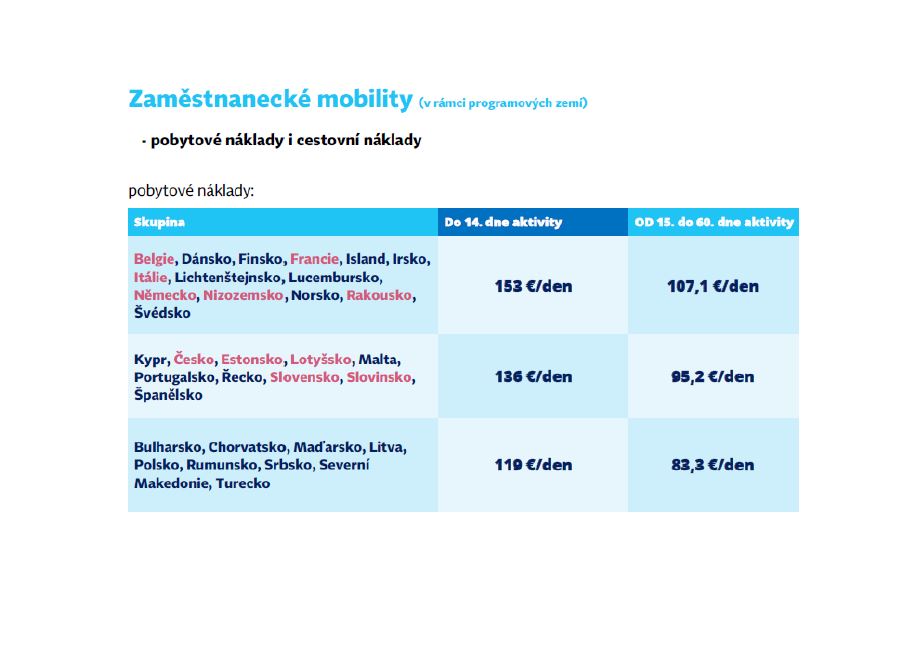
- Covers legal per diems (according to the Ministry of Finance decree – here), accommodation, local transport, and other necessary expenses (course fees, entry to public institutions, etc.). All expenses must be documented for reimbursement.
- Maximum daily limits of financial support are based on destination and listed in the grant differentiation table. The total grant is calculated by multiplying the number of eligible activity days stated in the Mobility Agreement.
- A working day is any day on which the employee performs eligible activities (teaching or training) in alignment with Mobility Agreement, even if it falls on a weekend or holiday.
- Important: Plan activities (teaching/training) on consecutive days. Days without eligible activities (excluding travel days) are not reimbursed (e.g., accommodation, per diems), and the business trip may need to be interrupted. If there are any uncertainties, always consult the responsible person from the Finance Office (https://www.ff.cuni.cz/home/faculty/structure-history/faculty-administration/finance-office/) or Ms. Beťková at RUK.
- Financial support for travel days is granted only in justified cases (e.g., if the teacher must be present at the host institution early the next morning). Usually, travel days are not reimbursed unless teaching begins on the same day.
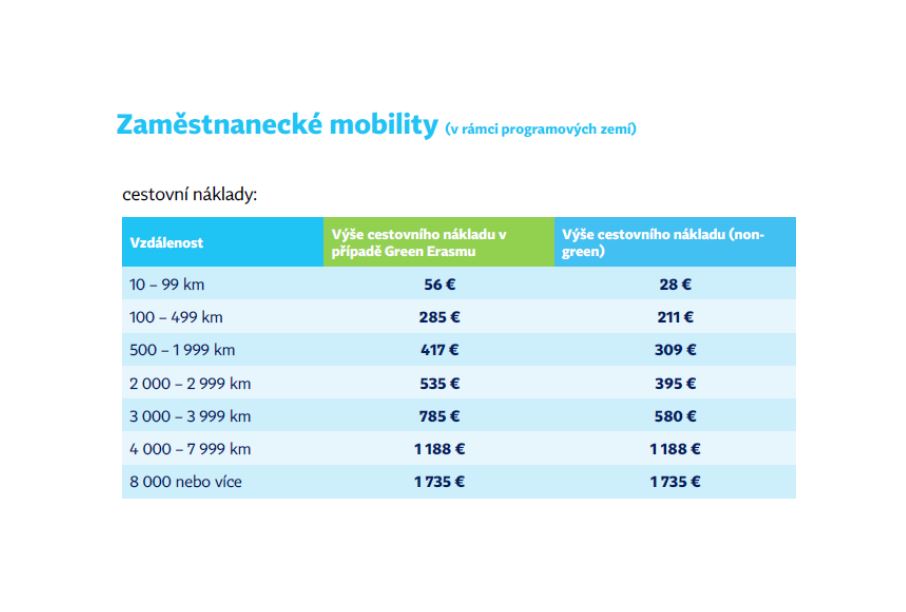
- Covers expenses for airfare, 2nd class train tickets, approved car use, and connecting transport to/from airports or stations.
Green Erasmus applies to travel by bus, train, shared car, or bicycle. - Maximum grant is based on distance, calculated using the official Erasmus+ distance calculator. The starting point is the workplace address (Prague), and the rate applies to round-trip travel. Refer to the travel grant table above for rates.
- Travel services should be purchased only after signing the Travel Order.
- The Participant Agreement is signed in cooperation with Ms. Markéta Beťková (marketa.betkova@ruk.cuni.cz)
The Travel Order form (PDF and Excel) and instructions are available on the EO Intranet.
The Travel Order must be signed before departure by the Head of the department/faculty unit or direct supervisor and the Head of the International Relations Office (Michaela Lemeškinová).
In justified cases, it may be signed before the Participant Agreement to allow early travel arrangements or advance requests.
After each trip, reimbursement must be processed through the Finance Office (EO). All documents and instructions for reimbursement are available on the EO Intranet. The employee is required to submit the travel reimbursement within 10 days of returning. All reimbursement documents (see below) must be submitted via the International Relations Office (ZO), which will forward them to EO after obtaining the necessary signatures.
Required Reimbursement Documentation:
- Travel Order (“Cestovní příkaz”) – fully completed (including second page) and re-signed by the supervisor and head of the International Relations Office
- „Vyúčtování pracovní cesty v zahraničí (Reimbursement of International Business Trip)“ form
- „Závěrečná zpráva ze zahraniční cesty (Final Report from International Trip)“ form
- All receipts, invoices, or documents proving entitlement to reimbursement, including proof of payment (e.g., bank statement)
Documentation for the Rectorate (RUK):
- The employee must also submit the original Confirmation of Erasmus+ Period Staff Mobility, again via the International Office (ZO), within 10 days after returning.
- Alternatively, a confirmation form from the host institution may be used, which must include: full name of the participant, exact dates of eligible activities (from–to, excluding travel days), confirmation of activities carried out according to the mobility programme, number of teaching hours completed (for STA) and, if applicable, confirmation of teaching/training conducted over weekends
- The employee also completes an online report (EU Survey), for which a link will be sent to their contact email.
All updated information, including relevant documents, can be found in full on the official website of Rectorate.
Contact person (Erasmus+ Faculty Coordinator): Mgr. Nikola Meryová (room 128)
Related regulations: Dean’s Measure no. 8/2022, Rector’s Measure no. 6/2022
Contacts
Staff Mobility Coordinator
Room 128, main building
Tuesday 9:00–12:00
Wednesday 14:00–17:00
Thursday 14:00–16:00