
Manual for receiving a foreign visitor

The rules for receiving foreign visitors at the Faculty of Arts, Charles University are governed by Dean’s Measure No. 12/2021 and Dean’s Measure No. 17/2025.

This manual is primarily intended for academic and research staff at the Faculty of Arts, Charles University (hereinafter referred to as the “guarantor”) who are planning to invite an international guest for the purpose of teaching or other professional activities.

This manual serves as a general procedure for a guest’s arrival; however, it is always necessary to check the specifics of the given project or funding source. Given the varying administrative requirements of individual projects, we recommend beginning preparations well in advance to ensure that all necessary administrative steps are completed on time. It is also advisable to individually consult regarding the recommended timeframe for preparation; in most cases, it is best to begin preparations approximately two months before the planned arrival.

The responsible person is the person in charge of handling the administrative aspects of the guest’s visit.

You (usually with assistance from the coordinator of the programme and the secretary) will also need to select a responsible person at the specific institute/department, who will assist with the practical aspects of the guest’s arrival (such as arranging transportation, accommodation, preparing the agreement – see below) and communicate with the relevant departments regarding all administrative matters.

Erasmus+

IRO – Coordinator N. Meryová + guarantor

Inter-University agreements

IRO – Coordinator N. Meryová + guarantor 

IRO internationalization programme

IRO – Coordinator N. Meryová + guarantor

Grants and projects

The project manager of the specific project / project

Defences 

SAO – the relevant SAO coordinator

Cooperatio

RO – Coordinator D. Stříbrný 

Self-funding 

The guarantor + secretary

Information about the guest’s stay must be entered into the Receiving a Foreign Visitor module in SIS.

You can find the manual for the Receiving a Foreign Visitor module HERE.

The data about the international guest is entered into the Receiving a Foreign Visitor module in SIS by the Guarantor (the person who invited the guest). Guests are registered if they are accepted:

  • within contractual cooperation based on inter-university or inter-faculty agreements concluded between the foreign university/institution and the Faculty of Arts, Charles University (CU FA) or the CU Rectorate;
  • within contractual cooperation based on intergovernmental agreements;
  • with secured internal financial resources for their stay at CU FA outside of contractual cooperation;
  • without entitlement to financial resources.

Guests are not registered if they are accepted without entitlement to financial resources and simultaneously:

  • are participants in conferences, summer schools, or similar events organized by CU FA and are independently registered within the event;
  • are participants in public events organized by CU FA;
  • perform activities at CU FA for only one day.

The Guarantor must enter the information about the guest’s stay at the faculty into the SIS electronic application no later than 14 days after the guest’s departure.

The Guarantor is obliged to inform the incoming international guest about the relevant internal regulations of CU FA.

If you have any questions, please contact the secretary of your department or the administrative staff responsible for the source of funding.

Charles University follows the counter-influence manual developed by the Ministry of the Interior of the Czech Republic.

The Counter-Influence Security Manager from the Security Department of the Rector’s Office, Ing. Valérie Hůrská, issues statements and recommendations regarding specific collaborations (vetting a given university, employee and/or student) in the following areas:

  • prevention of harmful influence on Charles University
  • efforts to strike a balance between open academic collaboration and the potential security risks arising therefrom
  • a specific process for vetting potentially risky partners

You may contact her if necessary.

You may also contact Bc. Michal Bílý, the Security manager at the Faculty of Arts regarding any security matters.


Administrative process of receiving a foreign visitor

This may involve funding to support the visit of a guest at the Faculty of Arts, Charles University; alternatively, the guest may come with their own funding or combine their own funding with partial funding from the Faculty of Arts or Charles University.

The guarantor is usually informed of the amount of the provided contribution or confirms it with the coordinator of the relevant funding source. At the same time, they are also informed of any specific requirements related to the given funding source. Once again, this depends on the type of grant or programme (the contribution may be a specific amount or cover only specifically defined costs, whether partial or complete).

If a guest’s visit is funded by the faculty (excluding Erasmus+ and inter-university agreements), it is necessary to enter into a so-called “unspecified contract” with the guest. In the case of financial support (such as reimbursement of travel expenses and/or accommodation), the requisition must be approved before the contract is signed. If you are combining multiple funding sources for the guest’s visit, there is no need to create a separate requisition for each source, but you must list all funding sources and allocate the individual amounts to the appropriate funding source (see below).

You do not need to create a requisition if the visitor has their own funding source.

The requisition is usually processed by the guarantor with assistance provided by the secretary.

You may create the requisition in IS VERSO at this link and follow the instructions:

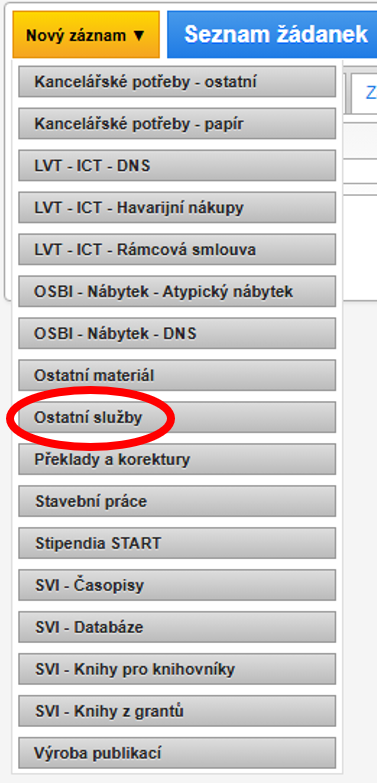
1. Click New record > Ostatní služby (other services) to open the details of the requisition
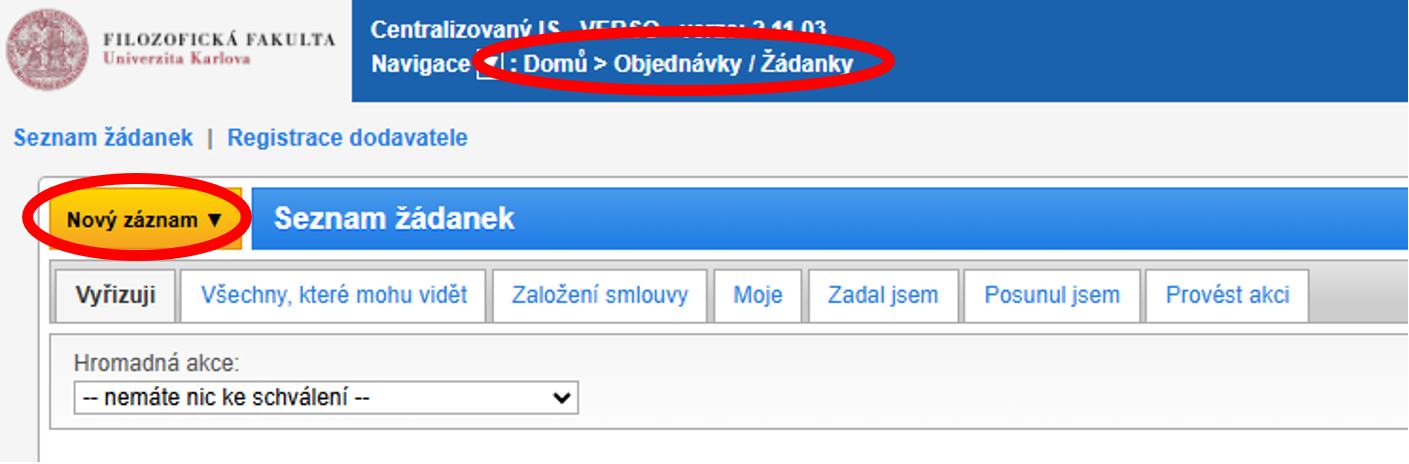
2. Header

  • Supplier: click via Text > “unspecified contract (+ name of guest)”
  • Contact person: the responsible person, see table above
  • Place of delivery: your department, institute or faculty administration office
  • Internal justification of the Purchase requisition: enter “unspecified contract + name of guest”
  • Do not fill out the other fields, fill out only the highlighted fields as seen in the image below
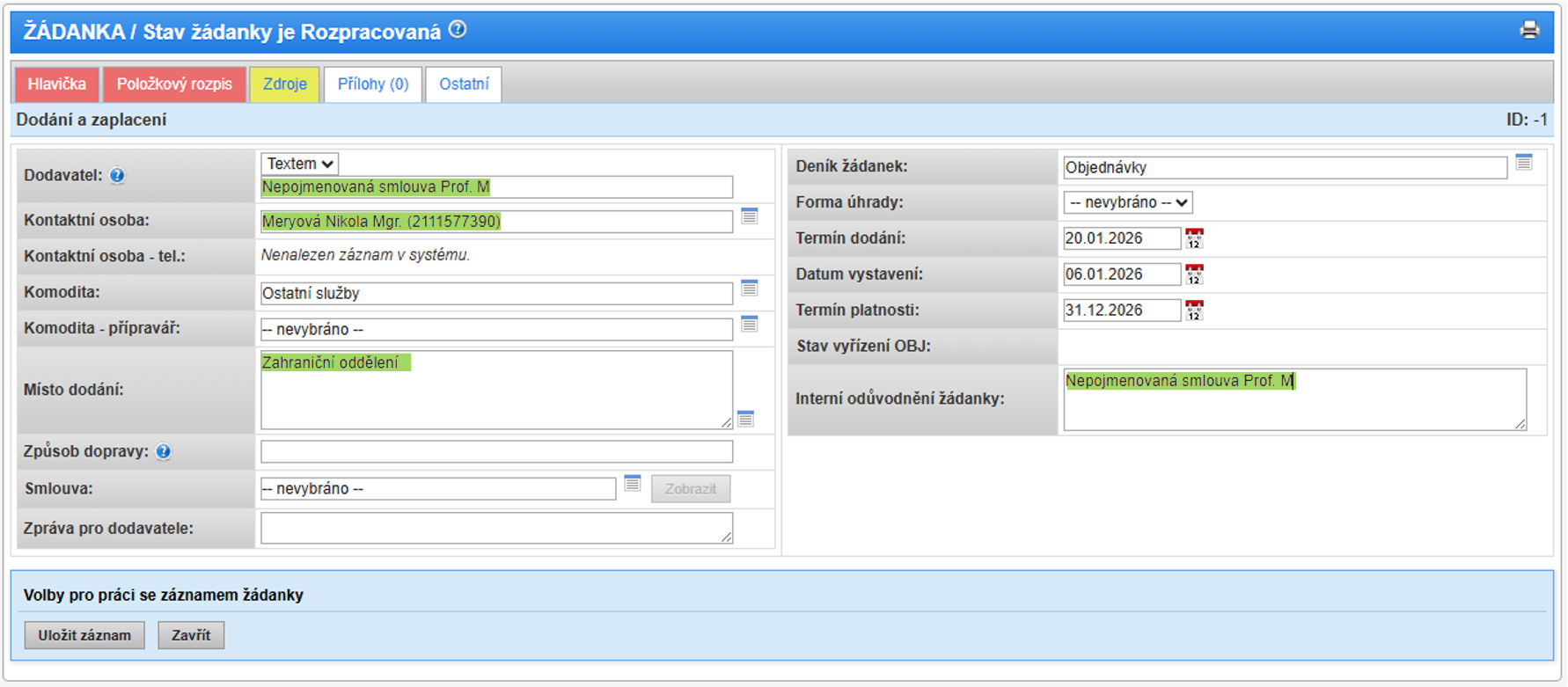
3. Itemized breakdown

  • List the prices with VAT included
  • Currency: check in which currency in which the contribution is allocated
  • Item: accommodation, flat rate or once again write “unspecified contract + name of guest”
  • Amount: 1
  • Price / IU: the full amount allocated (The requisition be filled out in Czech korunas, either for an approximate amount or for the full amount of the allocated contribution, even though most guests will be paid in a foreign currency)
  • Then check the confirmation box in the lower right corner
4. Resources

  • Cost centre: choose the centre from which the contribution was granted – this is usually the Projects and Grants Office, consult the project coordinator if needed
  • Contract: choose the order number (you may filter the search by number or name) – then check the information based on received instructions
  • The remaining relevant fields will fill out automatically
  • Add resource: if you are combining more funding sources, click on “Add resource” and follow the same steps as before. You will then need to allocate the total amount to each source.
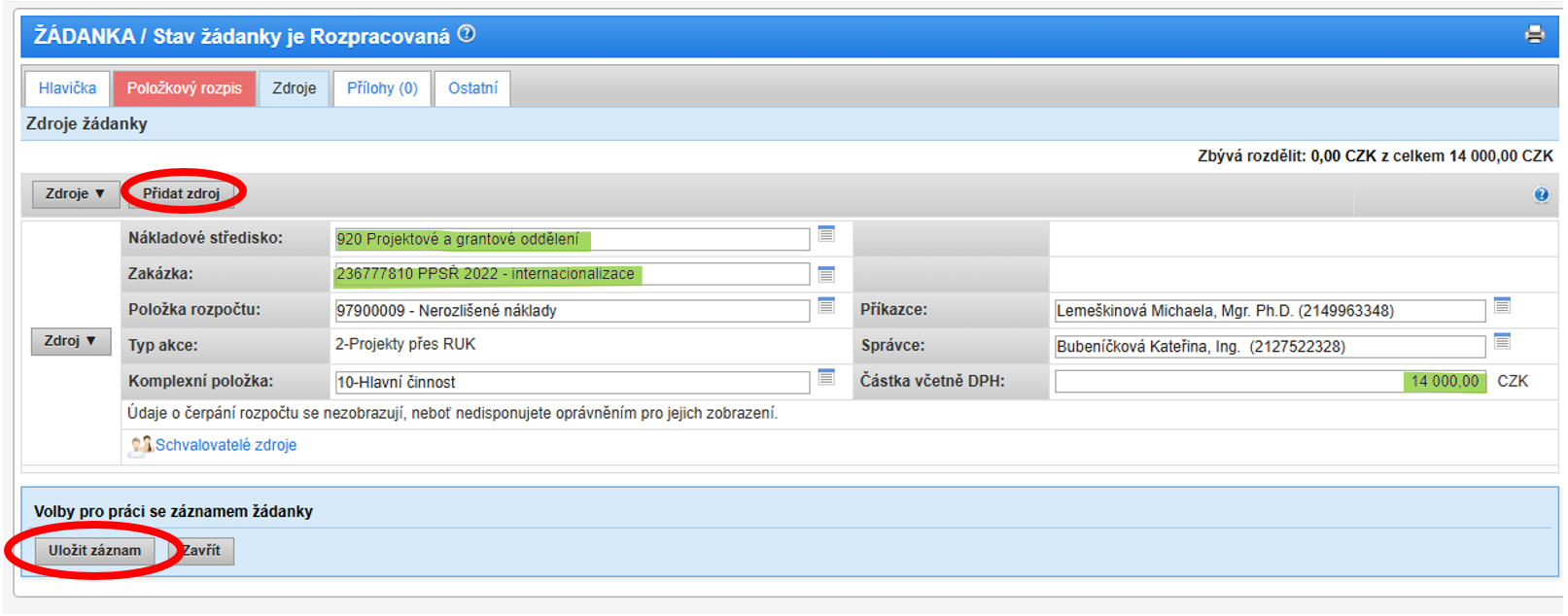
5. Click Save the record

6. Send the requisition over for processing

  • The requisition is first approved by the requester and then by the administrator. If the requisition is not in order, it will be returned for revision. The requester will receive a notification regarding both approval and, if applicable, rejection and return for correction.

You need to enter into an agreement with every foreign visitor, usually the Agreement on the Provision of a Contribution to Travel Expenses, but some grants and projects may have their own documents. You can find template agreements both in Czech and English on the intranet.

The agreement is usually prepared and entered into the module by the guarantor with assistance from the secretary. If you have any question, please contact the contract registry administrators, or the project coordinator.


When filling out the agreement, follow the instructions provided in the comments in the sample document on the intranet. List the responsible person (in this case, the guarantor, not the project coordinator) and their contact information in the header. Next, enter the accounting order number (or multiple order numbers depending on the individual funding sources). This is the same order number that was already listed in the requisition.

Article I Subject Matter of the Agreement

  • Make sure that the funding source in question does not have specific requirements regarding the content or type of agreement.

Each agreement must be entered into the SML Module before signing; log in using your usual credentials.

Once the request has been approved, enter the necessary information into the Agreements module and upload the prepared contract.

You must also upload all documents to be attached to the agreement.

Contracts must be entered no later than one week before they take effect.

After review by the contract registry administrators, the agreement is forwarded to the authorizing officer of the relevant agreement for approval. The agreement can be signed only once the contract has been fully reviewed and approved.

You may conclude the agreement either in paper or electronic form.

Electronic signature

  1. You may use the OBELISK platform, currently the preferred way of signing agreements at the Faculty of Arts
    • The signing parties need not have a qualified electronic signature.
    • The platform only allows for electronic signatures; you cannot combine an electronic signature with a physical signing.
    • When preparing agreements, it is important to inform the other party of the available signing options and to notify the contract registry administrators whether the person in question does or does not have a qualified electronic signature, or if they prefer to sign with a handwritten signature. This information must be entered in the Notes field in the Agreements module.
  2. When signing with a qualified electronic signature, you need to include a signature based on a qualified certificate or a qualified signature in accordance with Articles 3(11), 3(12), and 3(15) of Regulation (EU) No 910/2014 of the European Parliament and of the Council of 23 July 2014 on electronic identification and trust services for electronic transactions in the internal market and repealing Directive 1999/93/EC (eiDAS).

Analogue signature

If either party prefers an analogue (handwritten) signature, a scanned document cannot be accepted and the original paper document must be physically delivered. In this case, Legal Services will send two copies of the approved contract to the guarantor after review. The guest must sign the agreement no later than the first day of the event; they keep one copy and must return the other copy to Legal Services via the mailroom.

The visitor arranges everything at their own expense. The faculty will then reimburse the visitor for the full allocated amount in the form of a flat-rate contribution or for individual expenses based on submitted receipts.

The advantage of covering expenses at one’s own cost is that the guest can make choices at their own discretion.

The guest must submit all relevant documents for reimbursement within the specified deadline (usually 10 business days, as per the agreement). They must always provide a travel document (train ticket, plane ticket, etc.) as proof that they were actually there. They must also provide all receipts, invoices, and confirmations that document the purpose and costs. Specific programmes or grants may require additional documents.

In these cases, the purchase is handled by the supervisor, secretary, or project administrator. Once again, this depends on the specific instructions within the programme.

If an expense is covered by the faculty, it must be specified in the agreement. For example, an invoice for accommodation cannot be reimbursed if the agreement specifies that payment will be made in the form of a flat-rate contribution.

In the case of purchases on an invoice, the purchaser is required to provide the supplier with the faculty’s correct and complete billing information (the faculty’s official address, IN number, bank details, international bank details, and VAT ID number). The invoice must also include the name of the guest for whom the purchase is being made (e.g., in the invoice items or in a note). However, the guest’s name must not be included in the billing information.

An example of accounting information for an invoice issued to the faculty:

Charles University
Faculty of Arts
Jan Palach Square 2            
116 38 Prague 1

IN (identification number): 00216208
VAT ID: CZ00216208

Invoice:

Item: accommodation, first and last name of the visitor

Received invoices must be forwarded immediately to the Finance Office (FO) for payment, along with a cover sheet. Templates for cover sheets (for both domestic and foreign invoices), including instructions on how to fill them out, are available on the FO Intranet. The guarantor, with the assistance of a secretary, enters the invoice electronically into ESS and submits the physical copy via the mailroom.

If an employee places an order or makes an invoice-based purchase directly, the secretary is required to be included in the email communication.

All supporting documents related to the invoice must be retained for accounting purposes. Therefore, please make copies of these documents before submitting them to the FO for payment.

TIP: The Faculty has verified accommodation options from previous years that have proven reliable for hosting international visitors. You can find a list of these recommended accommodations below. However, as these are popular hotels, we strongly recommend booking your accommodation as soon as possible.

The prices listed are approximate only, they are based on our experience from previous years, so it is possible that prices have changed. We therefore recommend that you always check not only availability, but also the current pricing.

Opitz House (Celetná 14):

Number of guests

Single room (20 m2)

Double room (25 m2)

Suite (45 m2)

1 guest / night

1350,-

1350,-

2000,-

2 guests / night

1900,-

2400,-

parking / night

250,-

Breakfast + accommodation fee are included in the price.
Prices do not include 12% VAT.
Website: https://www.hotel.cuni.cz/en/

Hotel Masaryk Dormitory:

Single room: 1 100 CZK/night
Double room: 1 610 CZK/night
Triple room: 1 950 CZK/night

Breakfast, local tax and 12% VAT are included in the price.
Website: https://www.masarykovakolej.cz/en/hotel

Centrum Krystal:

Single room: 1 450 CZK/night
Double room: 1 700 CZK/night
Triple room: 2 300 CZK/night
parking in the hotel garage: 200 CZK/day

Buffet, local tax and 12% VAT are included in the price.
Website: https://www.centrum-krystal.cz/en/

Apartments Embassy

Since 2024, fixed prices are no longer set – approx. 3,000 CZK per night per room.
Current price upon request.

Website: https://www.apartmentsembassy.cz/en

Hotel Bookquet

Classic SGL/DBL: 3 090 CZK/night
Junior Suite SGL/DBL: 3 890 CZK/night
Bookquet Deluxe/Premium SGL/DBL: 3 590 CZK/night
third person in hotel room: +750 CZK/person/night
parking fee: +650 CZK/car/day (depending on availability)

Breakfast and 12% VAT are included in the price. The listed prices do not include the local tax of 50 CZK/person/day.
Website: https://www.hotelbookquet.cz/en

Hotel Sax

Room rates are not fixed; they depend on the room type, date, and availability. Rates are approximately 2,500 CZK per night. Breakfast and VAT are included in the price. However, the local tax of 54 CZK per person per day is not included.

 Website: https://www.hotelsax.cz/

Dormitories

Komenského, Větrník, Kajetánka – the price depends on the type of room (some dormitories have refurbished rooms available for UK guests), the specific dormitory, length of stay and season. The price does not include 12% VAT. You may contact the KAM Reservations Department directly to find out more about their current rooms on offer.

You may also use the services of a travel agency to make your purchase, such as:

The advantages of booking through an agency: tickets may appear cheaper on the website. However, the initial offers often do not include all fees (they exclude baggage and service charges), with the final price is only displayed when proceeding to checkout. In the event of potential complications (changes, delays, flight cancellations), it is easier to communicate with an agency representative than through the helpdesk of online booking sites.

Fees for the agencies mentioned above range from 200 to 500 CZK, depending on the type of service.

You may use the following e-mail template for ordering services from a travel agency:

Hello, I would like to request a quote for transportation / accommodation / both transportation and accommodation for the Faculty of Arts, Charles University, in accordance with the terms and conditions listed in the attachment. Payment: by invoice – to be paid by the Faculty of Arts, Charles University.

The order must always include:

  • the traveller’s full name as stated in the travel document
  • the traveller’s email address and/or telephone contact
  • date and place of arrival and departure
  • specification of the preferred connection or accommodation in the form of a link
  • in the case of air travel, specification of baggage (carry-on, checked)

Alternatively, please attach the request form (“Poptávkový formulář”) available on the ZO Intranet in the “Other” (“Ostatní”) section.

It is also possible to book tickets directly with specific carriers (e.g., České dráhy, Regiojet, Flixbus, various airlines).

You should always check with the project coordinator to confirm which expenses are eligible for reimbursement under the project or grant. You should also ensure that the agreement specifies either reimbursement via a flat-rate contribution or the specific expenses you intend to cover for the guest. Generally, however, the following can be reimbursed:

  1. public transportation fares (second-class train, bus, economy-class airplane) from the place of residence or workplace to the destination and back
  2. local public transportation fares at the destination
  3. accommodation at the destination 
  4. necessary incidental expenses related to the trip

However, it is always necessary to consider the amount of allocated funds and the rules for the specific funding source. However, it is important to ensure that they are included in the contract particularly with regard to incidental expenses.

Once again, it depends on the terms of the specific project or grant.

For accounting purposes, it is usually necessary to keep copies of all receipts that were used to support an invoice. These are then attached to the final report with a note indicating that they have already been paid.

In the case of reimbursement via a flat rate, it is usually sufficient to provide only a boarding pass or similar proof of the guest’s presence at the venue. Additionally, you must keep and submit all receipts that the guest wishes to have reimbursed.

Very closely. Purchases must be made in the most cost-effective for the employer possible.

That depends on the conditions of the specific project or grant. Please ask the project coordinator.

Please note that if your funding source does not allow for first-class travel, your travel expenses will not be reimbursed.


Administrative process after the foreign visitor’s departure

The contribution is not paid in advance, but only after the planned activity (e.g., teaching, conference presentation) has taken place.

Required documentation for expense reports

To pay the contribution to the visitor, an expense report must be completed. A template for the expense report form can be found on the FO intranet under the title “Expense report form (May 24, 2023).” A copy of the agreement and relevant documents that have been or are to be paid must always be attached to the reimbursement. In the case of a lump-sum contribution / “flat-rate contribution” paid to a guest, it is in most cases sufficient to attach boarding passes/tickets (or proof of accommodation).

Settlement Procedure

  1. Prepare the cash settlement along with the specified supporting documents.
  2. Submit the settlement for signature to the requester of the given contract, i.e., the person listed on the request form.
  3. Once all signatures have been obtained, submit it via the mailroom to the FO.

How to proceed if the visitor cancels their reservation

If the agreement has not yet been entered into the Module, you only need to notify the relevant project coordinator of the cancellation as soon as possible.

If you have already entered the contract into the Agreements module, you must also notify the contract registry administrators.

Inform the contract registry administrators. If the agreements were concluded in handwritten form, you need to return all existing copies of the agreement to the contract registry administrators (including agreements with only one signature at the time).