

Jana Mynářová from the Institute of Ancient Near Eastern Studies of CU Arts, has received the prestigious ERC Advanced Grant. The European Research Council (ERC) will provide 2,5 million euros (more than 60 million Czech korunas) in funding for her five-year project titled TENSION – Taxonomies of Interpersonal Violence in Ancient Mesopotamia. This is the second ERC Advanced Grant in a row for the Faculty of Arts at Charles University, and only the third of its kind in the Czech Republic.

photo: Hynek Glos / Forum Univerzity Karlovy
Professor Mynářová’s TENSION project will offer the very first complex look at interpersonal violence in everyday life in ancient Mesopotamia. Instead of the traditional focus on political history and the elite, the project instead focuses on the experiences of the common people and their everyday conflicts.
“We draw on an extensive collection of letters and legal texts that document the lives of ordinary people. We are interested in who committed acts of violence, who was their victim, where and when they occurred, and how such conflicts were resolved. In this way, we aim to challenge the widespread notion that early urban societies were, by their very nature, permeated by violence. On the contrary, we hypothesize that interpersonal violence was rather rare, tied to specific situations, and significantly influenced by social status, the environment and the methods of resolving disputes available at the time,” Professor Mynářová explains.
During its five-year course, the project will process more than 40 000 Sumerian and Akkadian cuneiform text from almost three millennia. A key component of the project is integrating traditional philological work with advanced digital methods. An international team of researchers will create a specialized lexicon of terms related to violence and will utilize natural language processing (NLP) tools, spatial analysis, and statistical modelling. The result will be among others an open-access corpus of data, a database of all recorded incidents, as well as the digital Atlas of Violence in Ancient Mesopotamia.
“Besides its scientific results, TENSION additionally represents an important contribution to the Institute of Ancient Near Eastern Studies. The project’s outputs will be based on open data and tools that can be used for further academic work, creating a long-term and sustainable infrastructure for both research and teaching. This can foster international collaboration, student involvement in research activities, and further development of our institute both at home and abroad,” professor Mynářová added.
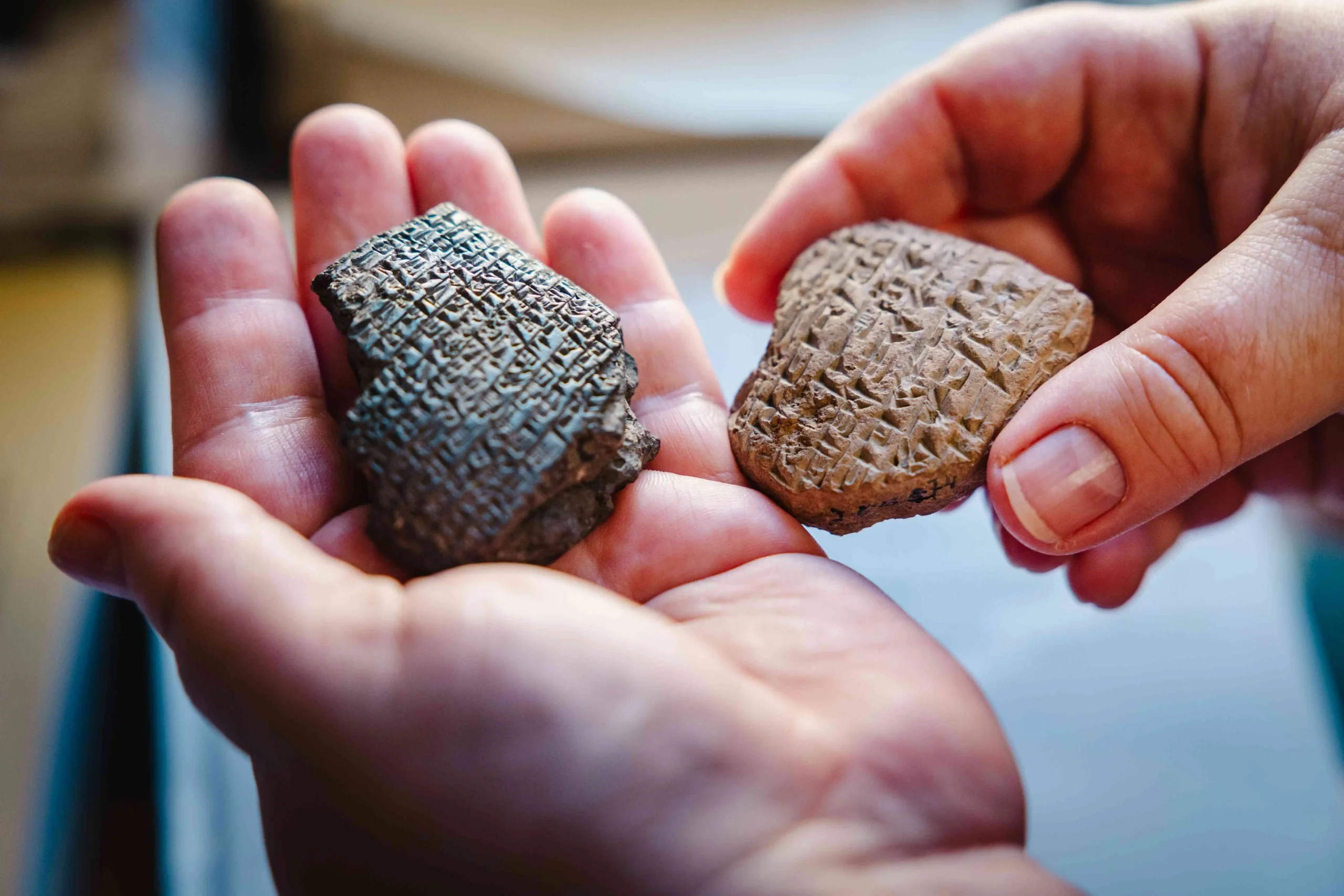
photo: Hynek Glos / Forum Univerzity Karlovy
3 329 proposals were submitted as part of this year’s call. Only 317 proposed projects have received funding, indicating a success rate of 9,8%. This is a monumental success for Charles University. Following the ERC Advanced Grant awarded last year to historian Kateřina Čapková, the faculty has now received the grant for two projects in a row. This is especially noteworthy in the field of Czech academia – in the Czech Republic, only three ERC Advanced Grants have ever been awarded in the field of social sciences and the humanities, now with two of them being granted to researchers at CU Arts.
“I am proud that Professor Mynářová from our faculty is now joining such a distinguished scientific community as the recipients of ERC Advanced Grants. Even during the preparation of her project, she has demonstrated outstanding qualities, which she will be able to fully showcase while working with her team on the TENSION project. This success also shows that our investment in ongoing support for applicants for prestigious European grants is clearly paying off,” said Eva Lehečková, Dean of CU Arts.
The second successful recipient of an ERC Advanced Grant in Czechia this year is Professor Konstantinos Kafetsios from the Faculty of Arts at Palacký University in Olomouc. Both principal investigators, Professor Mynářová and Professor Kafetsios, agree that their mutual support during preparations for the second round of the competition was very important.
“Experience shows that sharing, support, and collaboration among institutions and individuals during the preparation of ERC projects are the path to success and, at the same time, a benefit for the entire academic community,” says Štěpánka Gray Marková, who has long specialized in providing individual support to ERC applicants at the Faculty of Arts of Charles University and other institutions.
The ERC Advanced Grant is one of the most significant research awards in Europe. It is awarded by the European Research Council (ERC) based on the research excellency of both the project and its investigators. Applicants must present a ground-breaking contribution to their field and provide a unique research vision pushing the boundaries of current knowledge.
prof. PhDr. Jana Mynářová, Ph.D.
Assyriologist and Egyptologist Jana Mynářová works at the Institute of Ancient Near Eastern Studies at the Faculty of Arts at Charles University. She specializes in the political, social and economic history of Ancient Near East and is long considered one of the most prominent experts in the field of Ancient Near Eastern Studies.


doc. PhDr. Jana Mynářová, photo: Hynek Glos / Forum Univerzity Karlovy